Friday, 25 September 2015

Assumptions

When I first started wondering if I was a lesbian, I grappled with issues around presentation. I had read books about lesbian history, and all about the coded dressing that went on when lesbians couldn’t be out and proud… labrys earrings and pinky rings with a wink and a nudge. Stereotypes lived on with the idea in my head that most lesbians dressed like male truck drivers in steel capped boots and flannel shirts. The books I had read about middle aged women discovering their attraction to women advised that they go and mix and mingle with the ‘lesbian community.’ But…. how do you do that? For a start, I didn’t know where I’d look. And if lesbians dress like men, then how on earth would I fit in?

I read Lisa Diamond’s book about sexual fluidity, and got quite stroppy about labelling. Why have a label? I don’t need one. Plenty are doing without. I continue to be confused by all the issues around labelling and presentation, and even queer media seems to have different views.

Even in the last week, I read an article about femme invisibility being a ‘dirty secret’ of the queer community. That is, the lesbian community largely presenting as butch, and excluding and erasing women who identified as lesbian, but presented in a feminine way. You know - ‘You’re too pretty to be a lesbian.”

Then on the other hand, this piece was posted by an online magazine called ‘PRIDE’ which claims to be be a platform for queer millenials. Queer millenials seem to be throwing off labels, which then seems contrary to this piece which reinforces stereotypes about lesbians wearing boots and flannel shirts.

This is so incredibly problematic, as it is not only a community being non-inclusive, but doing so to the point of reinforcing stereotypes.

But this still happens, and I am utterly puzzled as to why. I tried joining a few lesbian Facebook groups, and the ‘exclusivity’ was annoying. I heard about a local lesbian event, and asked the administrator of one of the groups if she’d post it for member. “Oh, I’ll see what the organiser says. But its probably not necessary - its a well known event in the community.”

I see.

What if I don’t belong to ‘the community’ yet? How will I find out? Remember back at Stage One, where the books said ‘find the lesbian community?’ Well, how is that going to happen when the ‘community’ cloaks itself in some kind of exclusiveness?

I can understand discretion if you are doing something that is generally not approved of in society, but has ‘the community’ not realised that we have equality on pretty much all fronts? Any discrimination that lesbians face won’t be because they're gay - it will be because they’re women.

Other online magazines have been exploring the idea of doing away with labels, and celebrities like Miley Cyrus talk about ‘fluidity’ rather than taking on sexual identities related to attraction to any particular gender.

While I have been pondering what label to wear, I have enthusiastically posted articles about not labelling.

Then a lesbian friend said “But I don’t want people assuming I’m straight.”

She raised an excellent point, but I have explored that a bit further in my own personal context. I still don’t have a set identity. Other people label me as a lesbian, and that’s fine. I suppose I resist labelling because I think that there are more important defining things about me as a person than the gender of the person I’m in a romantic relationship with. In any case, labelling sexual identities is a relatively new phenomenon. We can thank the Victorians and their urge to catalogue and classify everything for that. 

And then I hit on it.

I don’t want people assuming I’m with a man.
I don’t want people assuming I’m married.
I don’t want people assuming I’m coupled at all.

I don’t want those things for anyone, actually.

Perhaps it was not so much that I don't want assumptions made about who I'm attracted to or romantically involved with or deeply in love with or having sex with. Because that's kind of personal, right? But more that I don't want about assumptions made about which societal box I fit into. As the writer of the article in DIVA said, In fact, by self-labelling as gay, my real intended meaning is that I don't fit the heteronormative category.

I remember when I was a newlywed nineteen year old I took a bit of pleasure in subverting people’s ideas about what I should be. So I suppose that’s an example in and of itself. 

Don’t assume that a nineteen year old isn't married, and don’t assume a nearly forty year old is.

And don’t assume all lesbians wear flannel.

Sunday, 30 August 2015

Still looking

While I was at university, I took advantage of having access to an academic library for my own self- development and exploration. There I discovered the writing of Tamsin Wilton, a lesbian academic from the UK. I had mostly read books written by and about Americans, so it was refreshing to read from a different cultural point of view. I enjoyed Ms Wilton's acerbic style, and wanted to seek out more of her books. Funnily enough, I cannot now find even the name the book I originally read of her's, and was also to find that getting hold of her other books was going to be no easy task. I managed to source two of her books in the UK via an obscure online seller.  

Finger-licking Good: The Ins and Outs of Lesbian Sex. 
1996.

Not as titillating as it sounds, this one was very political. It wasn't exactly what I was looking for, but interesting nonetheless.A book nearly twenty years old and written from a UK perspective was going to offer a view of a different world to twenty first century New Zealand. This book examined the patriarchal undermining of women's sexuality - both identities and activities - and how feminism and lesbianism intersected. Living in a world where people are increasingly choosing not to label themselves, the idea of the 'political lesbian' was an interesting one. One to read once, and I have since donated this one to The Charlotte Museum Trust.


Unexpected Pleasures: Leaving Heterosexuality for a Lesbian Life. 
2002
Always eager to read other people's stories, this was the book I really wanted to get my hands on. Ms Wilton did not write this book as an academic piece, but as a collection of stories supporting her own experience as someone who had lived a heterosexual life, and had not come out as a lesbian until her 30s. Of course there were many other stories I had read about the very same thing, but most were very old and very American. But one of the distinguishing features of Ms Wilton's point of view was that women make a choice. That it isn't necessarily a case of "Well, I always knew...but.." That they initially had enjoyable heterosexual relationships but later developed a lesbian identity.


I also stumbled across this one on Kindle. I was surprised that I hadn't found it earlier, but very glad I finally had.

Lesbian Epiphanies: Women coming out in later life. 
Karol L. Jensen, MPH, PhD. 
Routledge 1999

This book wasn't just about women's own stories, but also examined the society that kept them on the route of heteronormative marriage and family life. From the foreword by Paula Rust, 
"In great detail, she explores the ways in which females are socialized into ignoring their own experiences of self, particularly their own sexual desires, in favour of socially encouraged concepts of womanhood."
This book was important for me because of its exploration of many aspects of identity, and illustrates the power of our society's heterosexist and misogynist norms to shape our lives and experiences.


It seems a long time ago that I started searching for answers, but sometimes starting a journey of exploration throws up more questions than you thought to ask to begin with. I think we always seek to find validation in other people's experiences, because they make us feel less alone. It has been useful to absorb the stories of more women like me - like me not just because they were set on a journey of questioning their sexuality, but their whole identity. Its been good to discover that although it would be nice to look up a book or do an internet search to find an answer to my questions, that actually the journey is important. It teaches you things. It reinforces that you can't put people in boxes and that although we have things in common, that we are all individuals with our own paths to walk and discoveries to make.

Tuesday, 14 April 2015

Everything and nothing

Back in 2001, at the age of 25, I had a career crisis. I was working as a Training Manager for a large retailer, and they had recently introduced new systems for training staff through a structured programme. I was working with this programme day in and day out and was thoroughly versed in its application and use. Then head office invited applications for someone to run this programme nationwide. Perhaps naively, I applied for the job. I had no tertiary education, and was relying on my extensive experience to make me the best person for the job. But I wasn't. When I spoke to someone at the Human Resources department they told me that were looking for someone with a degree in Industrial Psychology. I was upset. Frustrated. Annoyed. And then I decided I needed to take action.

My husband and I were still renting our house, and the overwhelming societal message was that we should be buying. I wasn't sure how that was going to happen while I was still in a relatively low paid retail job. I was smart and knew that I needed to keep growing and learning so I wouldn't stagnate.  So I decided that I would look into doing some part time education in the Human Resources sector, get a better job and buy a home within the next ten years.

And then I unexpectedly fell pregnant.

We were surprised, but not unhappy. Children were always on the agenda, but the timing caught us off guard because our financial situation was not secure in the modern sense of the word. We didn't own a house.

Of course the model that my husband and I had both grown up with was with a stay-at-home mother, and the idea of going back to work with a small baby was unthinkable. At that time there was no paid parental leave anyway, but I did what most mothers did at that time, and that was to apply for and take the one year's unpaid leave. It turned out that in that time my role was phased out, so I would have had no job to return to anyway.

Pregnancy was easy, but I had a difficult and very, very long labour. I didn't sleep for over 48 hours, and after that I had a newborn who needed feeding every few hours. I remember feeling stressed by the relentlessness of his needs when I was so, so tired. Breastfeeding didn't come easily, and in the second week I was expressing milk because my nipples were so damaged. My son was bringing back milk with blood in it when it was at its worst.

I struggled with adjusting from full time work to full time motherhood, and to ease this transition I worked part time on the weekends from when our son was four months old. At first, I worked at my previous employer, and a few months later I found a better paying job somewhere else.

When our son was thirteen months old I found out I was pregnant again. In early 2003 I resigned from my job, and did not work outside the home again until 2008.

But what was I doing in all that time?  I became occupied with child and community oriented jobs. I joined a local Playcentre, helped as a session supervisor and participated in training in order to hold a qualification that enabled the centre to retain its license. I helped run a mother-to-mother support group, offering support and empowerment to other mothers.  I researched early childhood options for our son as he approached his third birthday. I had no car some days of the week, so I walked my son to kindergarten and back three afternoons a week. I breastfed the baby, I planned meals, I researched and prepared healthy food options for my family. I cleaned the house. Money was tight, so I made meals from scratch and researched how to make money go further. I took the children to Plunket and the doctor.

In 2004 the old societal guilt trip about not owning a house reared its head again, so I started applying for jobs and researching daycare. I was offered a job by a former colleague from my retail days, but I remember standing in the middle of the local fruit shop with my then eleven month old and realising that I couldn't in good conscience put him in daycare at that age and so I turned the job down. The house would have to wait. Or not happen at all.

In 2006 we moved to a whole new suburb, and not long after, our daughter arrived. With a four year old and a two year old, I researched local early childhood centres, visited the local kindergarten to get a feel for it, did all the paperwork so that our son could transfer from one kindergarten to the new one. As he approached his fifth birthday, I accompanied him on school visits. I enrolled him at school. I took my son to school and home again, as well as taking his brother to kindergarten and caring for a new baby, who mostly just fit in with whatever was going on. I took on many jobs within my volunteer mother-to-mother organisation, which enabled me to be involved in community service without compromising my children's care while they were small.  I worked part time as a homebased daycare educarer, which meant I could earn myself a bit of pocket money, but again, not compromise the needs of a baby and preschooler.

In 2008 I found a job outside the home, and decided to apply for it. It was in a public library, and it was the best job I have ever had. I found it encompassed all the things I enjoyed about retail, yet none of the negatives. I could be of service to the community, but didn't have to aggressively sell anything. My husband looked after the children so we didn't need to utilise daycare.

In 2009 our last child arrived. But this time the country had moved on, and I was able to take advantage of four months of paid parental leave. Most of it was lost in a blur of worry and stress over a baby that would not feed properly and not put on weight. I was able to go back to work on reduced hours, and ease myself back into my usual two full days a week by the time our son was six months old. I was working on my husband's days off so that we didn't have to utilise daycare, and our small baby could still be in parental care. Eventually the strain of one of us always being at work, alongside growing boys' weekend sports commitments meant it was time to move on to a weekday job. As it happened, my children's school had a vacancy for a library assistant, so I approached the school principal about taking the role, and she agreed to me taking it.

I was devastated about leaving the public library job, and hoped that I might be able to return to that sector one day, but right now this was a choice I needed to make for my family.

Due to my youngest son's age, an in-home nanny seemed to be the best option for his care. I searched and interviewed until I found the right person.  I spent a greater part of my wages on the nanny, but figured this would pay off in the longer term because I had secured a job, and soon I could access government subsidies for childcare once our son was old enough. My knowledge of child development meant that I had an awareness of what he would be able to manage in terms of non-parental care, so in time he moved on from the nanny in our home to being cared for in someone else's, and then, after more research, to a small, friendly daycare centre, and finally, to the kindergarten that his siblings had attended.

In the meantime, both my parents died, and my life was turned upside down. I began re-evaluating my entire life. As I have already written about, I went to therapy to help deal with anxiety and panic, but the therapist uncovered much more - I had experienced a loss of autonomy. I had lost myself. At the time this was uncovered, it was all I could do just to manage the immediate problem of my anxiety and panic. But it wasn't going to go away.

By that time I had spent eleven years in service to my family and community. My community work was for my own benefit as well, as it kept my mind engaged in things outside child rearing, but it was still child-centred. I was able to sit on a board of a non-profit organisation, but I was still on 24 hour mother duty as I breastfed a baby at the board table. I grew a social media site for my volunteer organisation around cooking dinner, vacuuming the floor and taking children to swimming lessons.

The day before I left my husband and family home in 2014, I also saw a therapist. I wanted to address two things. Questions about my sexuality, and my child rearing burnout.

I was tired. So tired. The therapist agreed I was burned out.

I probably should have stayed and worked through those feelings, but there were so many feelings, and they were so overwhelming, I ended up needing to take action. I needed to run.

People refer to the analogy of the airplane emergency procedure where you are told to put your oxygen mask on before you attend to anyone else.

I had spent years keeping everyone else's oxygen going, and although I tried to secure my own mask, now I was suffocating.

Even though I ran, I still saw and cared for my children every day. But I needed to hunker down and take care of myself, too. Weekends away weren't cutting it. They just meant I had to go home again and I didn't want to. Having more money thanks to an inheritance didn't help. What I needed was space.

A year on I have worked out what was suffocating me. I have learned how to put in place boundaries for children that ensure that they still feel cared for but I don't end up emotionally exhausted.

Back in 2001 my husband and I made the choice based in our shared values that I would stay at home to help look after our family. At university I have learned that what we were doing was market and non-market work. Because we believed in the value of a primary caregiver being a constant in a baby and young child's life, it mostly fell to me, as the stay at home parent, to do the other non-market work as well.

Since making those choices, it seems there has been a shift in society where I am expected to provide for my children equally. As a feminist, I think this is great. However, there are huge problems for women who have bought into the ideal of the 'bring home the bacon' husband while they stay at home with the babies. Many made those choices years ago, before society moved on, and now they are trapped and suffocating too.

I have no education because I gave it up ... twice. Firstly for a man. Secondly for my children. I tried very hard last year to finally have a third chance, but it was too financially and logistically difficult.

I have spent more than a decade putting my children first. I am desperately trying to balance putting my children first, but doing it without losing myself again. I have worked in my children's school for five years, and am still known by many not as 'Dania from the library,' but as 'Jacob's Mum' or 'Freya's Mum.' I can't provide for anyone beyond myself because I am not qualified enough for anything beyond minimum wage employment. I work in my children's school because it means that I can see two of them every day, and that I don't have to work late nights and weekends and have them in someone else's care when they are with me.

Now, nearly at the age of 40, I am worse off financially than I was in 2001 at the age of 25. This is the price that many parents, overwhelmingly women, pay for being the non-market workers in our society. For being the child carers, the cooks, the cleaners, the taxi service, the social arranger, the thrifty shopper, the medical assistant. Sometimes juggling low paid work outside the home. Sometimes trying to run a business in the home. Sometimes volunteering in early childhood services, schools, community groups so that they can spend time with other adults. They might make this choice willingly, but I'm not sure they always understand what they are giving up. I certainly didn't.

Its sad that we live in a world where we end up being punished for nurturing. But ultimately we do. And then when we claim ourselves back we are told we are selfish.

Never again.
Not for me. Not for my daughter.
Never again.

And I still don't own a house.


Thursday, 15 January 2015

Normal and ordinary

In January I literally fled my family home, with an intense need to escape my old life.  During this turbulent time of transition, I lived in a caravan park, and went to my children's house every day to get them ready for school and later in the day, to collect them.  Twice a week I would stay over, sleeping on a camp stretcher in an upstairs living area.

During this time, Nyah and I looked for a house that would tick all the boxes of being affordable, being big enough to house four children some of the time, and being close enough to access school by car or public transport.

I started university and was living in a swirl of emotions running high with tensions between myself and an understandably very angry ex-husband, trying to find and organise a new home, trying to get my head around academic life and still go to work and care for my children during the agreed time.

I naturally had to sensitively approach the fact that Nyah and I were in a romantic relationship, and to tackle how our sleeping arrangements would work.

Mr12 decided that it would be most appropriate if I slept on the couch when he and his siblings were at my house, and I readily agreed.  I wanted to be sensitive to his comfort levels, being conscious that he is an adolescent boy just beginning to make  sense of issues around sexuality and romance.

I gently probed the other children about what their feelings were about Nyah and I sleeping in the same bed.  Mr10 declared he didn't care so long as he didn't have to see it.  Miss7, who is a perceptive wee thing, said at a later time that she knew the big boys didn't like it, but she didn't mind.  Mr12 had declared that it wasn't ok, and it never will be.

So, the children started coming and I started sleeping on the couch.

Quite aside from missing Nyah, the couch is uncomfortable, and it was cold.  I managed to wrap up warmly in a sleeping bag, but I was certain the sagging frame would soon take a toll on my back.

In a moment of lucidity that snuck through around the anger, my ex had stated that maybe it would help 'give them an open mind' to live with two women some of the time.  In other words, help re-write the hetero-normative script in their heads.

As the second round of school holidays approached, the thought of nearly two weeks on the couch became a bit much.  I was thinking about how I could be sensitive to adolescent boy sensibility, but at the same time not keep the nature of our relationship hidden.

Slowly compromises were made such as sleeping with the door ajar and getting up when Mr12 did.  As time went by these concessions were no longer required, and our own household routines and systems have formed.  The kids aren't allowed in mine and Nyah's room, but they do know that if they wake in the middle of the night they only have to knock on the door (or in the case of Mr5, call out) and I will immediately get up to them.  I will still change wet pyjamas or lie with a child scared of stormy weather.

I think time has passed and trust has been re-established, and there is nothing to fear from mine and Nyah's relationship.

The last weekend the kids were here, Mr12 was playfully acting like he was going to step over the join in the carpet that marks where the lounge finishes and the bedroom starts.  I was making the bed, and pretending to growl at him.  Then we had a conversation about who sleeps on what side of the bed and why - I am on the door side because I get up first when the children are here, and because then I can easily get up in the middle of the night if I'm needed.  Its too hard to get out from the other side, I explained, because the room is so small that the other person has to climb.

As if it was some kind of mental slapstick comedy sketch, Mr12 laughed at the prospect of a grown woman scrambling over another to get out of the room.

Not just the 'ok' he swore it never would be.
It was all just normal and ordinary.

Monday, 1 September 2014

Finding my tribes

Photo credit:www.gaynz.com
As the New Zealand election campaign ramps up, I have, for the first time, begun attending election forums where candidates from each party put forward their policies about specific issues.  So far I had been to a forum on women's issues, education, and this week I went to the only forum in Auckland covering LGBTI issues.
This popped up on my 'events' on Facebook, and at first I dismissed it as irrelevant.  I have been resistant to the idea of being a part of the LGBTI community, because I didn't feel any need to for my own personal reasons, and maybe partly because I wasn't sure I fitted anywhere within the LGBTI alphabet soup.  Books I'd read said to go out and find the lesbians and hang out with them, but as a woman under 40 I wasn't sure if 'Lesbian Games Night' at the local Women's Centre (the only lesbian social activity I could find) was really going to be my thing.

I wondered what 'issues' might be relevant to the LGBTI community, because it seemed to me that many of the battles of the past had been won.

When I was a young Mum, I sought out the support of other people like me.  I found I was always a bit of a misfit amongst my mother peers, who were sometimes older, and mostly more wealthy than me.  However, we found common ground in our parenting styles, and for a long time I was a member of a mother-to-mother support group where I could be with mothers who mothered like me.  We perhaps had very little else in common other than that we had particular beliefs about how babies should be parented.  Often we talked about the solidarity and encouragement we felt from being with members of our 'tribe.'   I have recently left that organisation, simply because I have moved into new stages and my 'babies' are now aged five and over. When it comes to parenting, my concerns are more about education and behaviour than about sleep and feeding.

As I was driving home one evening (I do lots of thinking while I drive) it occurred to me that my tribe alliances were shifting.  I was becoming more interested and concerned about issues that effect different parts of me - issues that are important to me as a student, issues that are important to me as a mother of school children, issues that are important to me as a member of the LGBTI community.  Then it struck me - I had identified myself as being part of a community that I had initially dismissed as not needing.  I don't think it was appropriate to go looking for that community a year ago, but I suppose over time I have grown into it.

I wrote about a lack of hostility that I feel as a queer middle aged woman, so I took for granted that this lack of hostility exists everywhere.  However, it occurred to me that there are still battles to fight.  Adoption law needs overhauling, and transsexual people are facing uphill battles around how they are treated in the health and prison systems and within human rights legislation.  I am not being forcibly separated from my children and haven't lost my job because I'm in a lesbian relationship.  I realised that I take this for granted, but it wasn't always this way.  It is a great credit to activists before me that I can take these liberties for granted - I'm sure they hoped for a world where this might be possible.

So I think its only reasonable to 'pay it forward' so to speak.  I don't have to fight for the freedom to live how I choose, and if dealing with people's assumptions is the worst I have to deal with, then life is good.  At this particular time in my life it might only be weighing up issues in order to choose who to tick on a ballot paper, but I suppose turning up at a public forum to hear what the issues are to begin with is a start.

I learned more than I thought I would.  The visibly awkward right wing participants felt the world was rosy, but the gay/trans/ally candidates from other parties had a different story to tell.  I learned about gender discrimination and heterosexism in sexual health matters, that trans people have to fight to be recognised as human under our human rights legislation, and that things were not as rosy as we think for queer high school students, who still face unacceptable levels of bullying, and schools that are failing to keep them safe.

Afterwards, Nyah and I had a discussion about how these things would affect our children and her grandchildren.  These weren't just LGBTI issues, but issues that had the potential to touch all of both our families.

Children are not islands and it take a village to raise them.  This forum raised issues that could be a concern to me as a member of the LGBTI community, but moreso are a concern to mine and my partner's children and grandchildren.  Is my son going to be taunted at high school for having a lesbian mother?  Why should Nyah's granddaughter be the assumed conduit to keep boys safe from the HPV virus?  What if one of our children or granddchildren is gay?  Will they be safe at their school?  If one of them is actually a gender not aligned with their sex?  How will the world and the law see them?

They are issues for us as members of the LGBTI community.  But they are also issues for everyone.

Rundown of the AUSA Pride Week LGBTI election forum are here.http://www.liveblogpro.com/event/53fec1060e4a85d4718b458d


Monday, 25 August 2014

Marmalade

As Nyah and I set up our new home, part of what we have done is bring in items with stories and sentimental value.  Everything in our home has meaning, and telling our stories to each other has been an important part of our journey.  We embrace reusing and recycling and the philosophy behind buying second hand when we can.

Amongst my treasures is a bag of my mother's and grandmother's recipes.  In this I found a little notebook with the quantities required to make marmalade.  The front yard of our block of flats has a grapefruit tree, so I decided that I would have a go at making a batch.  First of all I gathered some jars.  Some we already had, but I bought some more cheap jars from the Salvation Army.  Many of these jars had labels attached, and it turned out to be quite a performance to remove them.  They were soaked and scrubbed and in the end had to use a citrus oil concoction to remove them.

I explored the concept of labelling in my last post with regards to sexual identity, but finding identity is many faceted.  My recent learning at university has been that the 'sense of self' is never truly established, but is an ongoing process.  That was good to know.  But what I have also learned is that people like to make order of the world, so will label things the way they see them according to the 'rules' that exist in the culture they live in.

Between us, Nyah and I have eight children, and she has eight grandchildren.  With her children grown, she didn't want to 'parent' again, but is happy to share our home with my children part of every other week.  I take care of the parenting in terms of sorting school things, taking kids on outings, putting them to bed, and she offers support by backing up my instructions and actions.

In some ways our family is unusual in that it doesn't fit the socially endorsed nuclear family of mum, dad and 2.5 children.  This model is probably in the minority (a book I read suggested that in the UK the traditional nuclear family makes up only 7% of all family units)  and even our 'unconventional' arrangement has labels.  Statistics NZ would call us a 'non-blended step family.'  Te Ara - The Encyclopedia of New Zealand defines a family where a parent's new partner doesn't parent as a 'recombined family'  For a while we even struggled with the term 'partner' because our relationship was so new.  There seems to be missing language when it comes to families and relationships.

As our relationship became more familiar to family and friends, they started making labels for us.  Nyah took her granddaughter out for her birthday, and they had a conversation about her father's partner - whom she referred to as her step-mother.  Then she said "You're a step-mum too, eh Nana?"  

My daughter's friend came to play, and concluded that if Nyah and I got married, then Nyah would be my daughter's step-mother, but at the moment they were just friends.

Everyone wants labels for what they are looking at.  I have become a 'lesbian mature student' (according to a family member) and Nyah has suddenly become a 'step-mother' to a gaggle of small children the same age as her grandchildren.  Maybe those labels will work for us eventually, but that's really something only we can decide, not everyone else (other than Statistics NZ, apparently).   But it looks like we have to accept that people will give us labels that suit what they are seeing, not what we actually are.  

The instructions say that once the marmalade is made, the jars are to be sterilised and the marmalade is to be poured into them.

They are to sit for a while and cool.

Then they can have a label put on and the jars house something new.


NB: To date I have not actually managed to make marmalade.  My unlabelled jars sit in the bag on the kitchen floor, and the grapefruit are still on the tree.  Maybe next weekend....


Monday, 18 August 2014

A bibliography of self discovery

I'm quite good at researching stuff.  When it comes to children's issues, mothers' issues, social issues....just stuff I'm interested in, I will read.  I read sociology books for fun.  I'm that nerdy girly swot.  So, when it finally became time to start looking at myself, I started to try to track down every website, web article and book I could get my hands on.  I'm still reading, and I'm still learning things.  And everything is shaking down just as it needs to.  Here is a list of books that I have found incredibly useful in my search for myself...

Outspoken: Coming out in the Anglican Church of Aotearoa New Zealand - Liz Lightfoot
University of Otago Press 2011
My review on Goodreads is here.  I actually put this book in this post last, but realised that it needed to go at the top of the list, as it was so important.  It was the book that finally kicked any vestiges of my internalised homophobia to the curb.  I initially read it because I know the author.  It may have changed my life.


Living two lives: Married to a man and in love with a woman (2nd edition) - Joanne Fleisher
2011 Lavender Visions Books 
I really recommend this book as it written in a very gentle and optimistic way.  This blog entry on the Huffington Post page sums up her own situation.


Late Bloomers: Awakening to Lesbianism After Forty - Robin McCoy
Writers Club Press 2000
I'm not forty yet, but I found the stories entertaining and interesting.  Many of the stories resonated, and offered reassurance that my experience was not a lone one.  It was one of those books where I saw my life in the pages before me.


Dear John, I love Jane - Candace Walsh and Laura Andre (editors)
Seal Press 2010


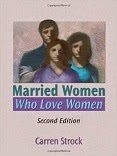
Married women who love women (2nd edition) - Carren Strock, Routledge 2008


And then I met this woman: Previously married women's journeys into lesbian relationships - Barbee J. Cassingham and Sally M. O'Neill

Mother Courage Press 1993
This book contained the stories of women living in 1970s and 80s America, where the culture would be very different to New Zealand in the 21st century, so I was less likely to meet the same challenges.  But some of the stories resonated strongly.

Look both ways: Bisexual politics - Jennifer Baumgardner
Farrar, Straus and Giroux 2007


Remember Us: Women who love women, from Sappho to Liberation
- Miriam Saphira (editor) with Heather McPherson and Dr Fran Marno
The Charlotte Museum Trust 2008
This was a great, easy read book about the history of lesbian culture in New Zealand

How To Come Out - Guide for Women Questioning Their Sexual Orientation - Essie Reis
Essie Reis 2012


Coming out and disclosures: LGBT persons across the lifespan - Ski Hunter
Harworth Press 2007
I found this book by chance at my local Salvation Army store.  I have not read it in its entirety, but did read the part about coming out later in life.  There were sections that made me gasp as I recognised my own life in the words before me.


Sexual Fluidity: Understanding Women's Love and Desire - Lisa M. Diamond
Harvard University Press 2008
At the time of writing, I'd not actually finished this book yet, but it offered up some great potential answers to questions I had about why I'd not 'known' about being attracted to women earlier in my life.


Gaga Feminism: Sex, Gender and the End of Normal - J. Jack HalberstamBeacon Press 2012
This book was revelatory to me while I was in the middle of the process of questioning everything about my life.  This book presented the possibility of a different kind of normal.


The Whole Lesbian Sex Book: a passionate guide for all of us - Felice Newman
Cleis Press 2004
Once upon a time I wouldn't have confessed to reading a sex guide.  Actually, I never would have read a sex guide.  But you know, if you are figuring stuff out about yourself you may as well cover all your bases.  In all seriousness, though, the byline for this book is 'a passionate guide for all of us.'  If nothing else, it answers questions about what lesbians actually do in the bedroom with ideas that aren't from the perspective of male fantasy porn.


All the reading I have done helped me understand that the patterns of my life are common to those of many women.  I have only listed the books I've read, but there is a lot online too.  I have posted them because this is a list I could have used, and maybe it will be useful for someone else.

No matter what you're questioning in life, I think it always helps to read.  It helps to explore your own feelings and your own past, and also to find what experts say, but I think most importantly, to find out what other people just like you have to say too.

I sourced my books from Amazon (on Kindle), Auckland City Libraries and Auckland Women's Centre.